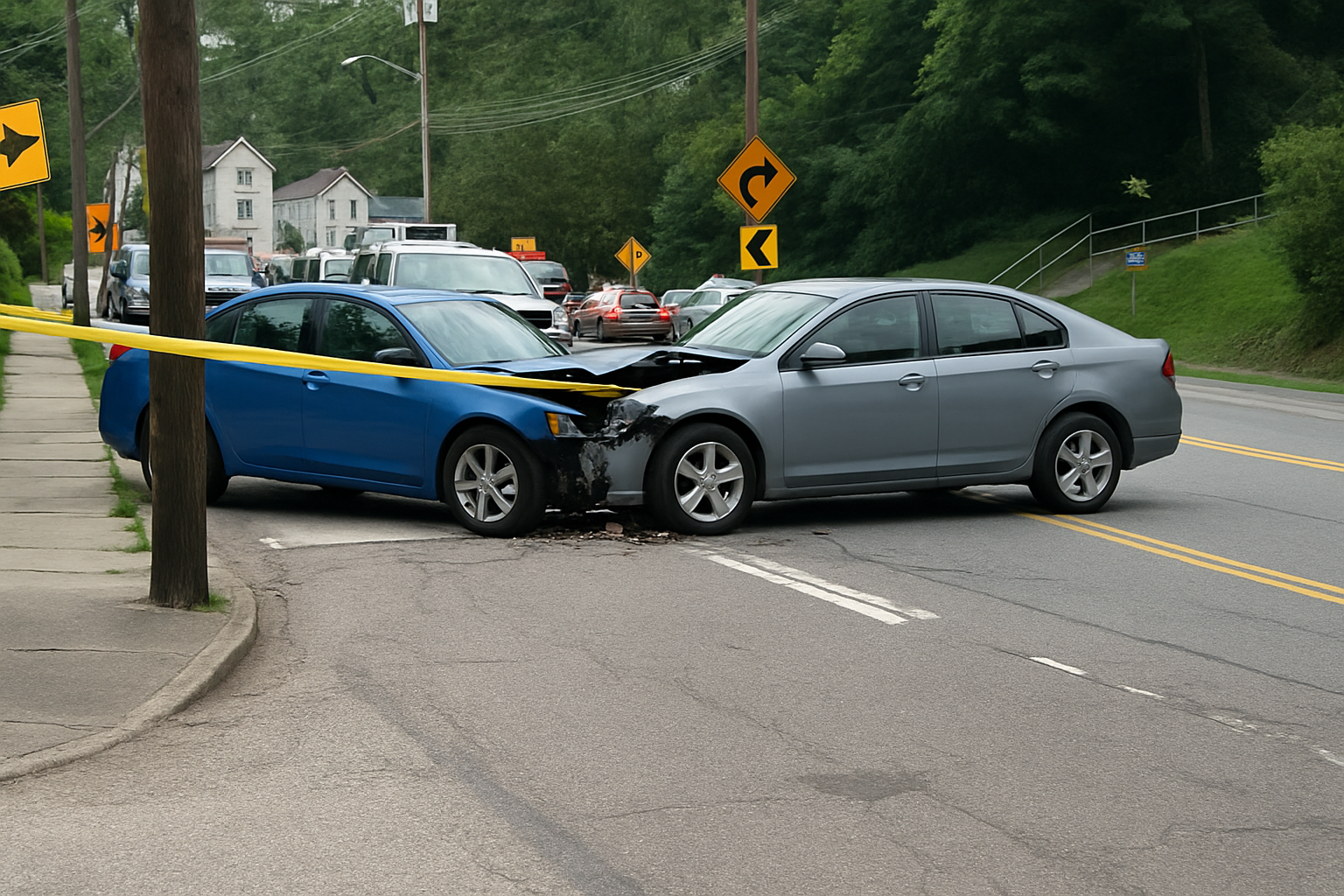
You got a ticket or had an accident in Lexington, and your insurance premium jumped. Here's how long Kentucky's point system will affect your rates, what you can do to recover faster, and which carriers actually compete for drivers with points.
How Kentucky's Point System Affects Your Insurance After a Violation
Kentucky assigns points to moving violations that stay on your driving record for 2 years from the date of conviction, not the date of the offense. A speeding ticket 15 mph over the limit adds 3 points. An at-fault accident adds 4 points. Reckless driving adds 6 points and triggers an automatic suspension. The state suspends your license if you accumulate 12 points in 24 months, but your insurance company starts raising your rates after the first violation — usually before you even know how many points you have.
Insurance companies in Kentucky don't use the state point system to calculate your premium — they use their own internal risk scoring. A single 3-point speeding ticket can trigger a 20–35% rate increase at most carriers, depending on your prior record and the insurer's violation surcharge schedule. A 4-point at-fault accident typically increases rates by 40–60%. These surcharges apply for 3 years in most cases, even though the points themselves fall off your Kentucky driving record after 2 years. That mismatch is why shopping carriers after a violation matters more than waiting for points to expire.
Kentucky does not require SR-22 filing for standard point violations like speeding tickets or at-fault accidents unless your license was suspended or you were convicted of driving without insurance. Most drivers with points in Lexington do not need SR-22 — they need a carrier that prices their specific violation type competitively. If your violation did not involve a suspension, DUI, or insurance lapse, you are not in SR-22 territory. You are in a rate recovery situation, not a compliance crisis. Kentucky's SR-22 insurance requirements
When Points and Rate Surcharges Actually Fall Off in Kentucky
Points disappear from your Kentucky driving record 2 years from the conviction date, but that does not mean your insurance premium returns to baseline on day 731. Most carriers apply violation surcharges for 3 to 5 years from the date of the incident, regardless of when Kentucky removes the points. A speeding ticket from March 2023 will fall off your DMV record in March 2025, but your insurer will typically continue applying a surcharge until March 2026 or later — and some carriers keep violations in their underwriting for up to 5 years.
The only way to know when your specific surcharge expires is to ask your insurer directly or review your policy declarations page for the "chargeable incident" expiration date. Many Lexington drivers assume their rate will automatically drop after 2 years and never follow up — leaving hundreds of dollars on the table. If your violation is past the 3-year mark and your rate has not decreased, request a policy review or shop competitors.
Kentucky does not offer a state-sponsored defensive driving course that removes points from your record. Some states allow point reduction through traffic school, but Kentucky is not one of them. Completing a defensive driving course may qualify you for a small discount with certain insurers — typically 5–10% — but it will not erase the violation or shorten the surcharge period. The highest-leverage action available to you is switching carriers, not enrolling in traffic school.
Which Carriers in Lexington Actually Compete for Drivers with Points
Not all carriers price violations the same way. A speeding ticket that triggers a 30% increase at one insurer might add only 15% at another, depending on how that carrier weights the violation type and your overall risk profile. National carriers like State Farm, Geico, and Progressive all write policies for drivers with points, but their surcharge schedules vary significantly. Regional carriers and non-standard insurers — including Dairyland, The General, and National General — often offer lower rates for drivers with multiple violations or higher point totals, though coverage options may be more limited.
In Lexington, the most common mistake drivers with points make is staying with their current carrier after a violation and accepting the rate increase without shopping. Loyalty does not reduce your surcharge — competition does. Carriers know that drivers with violations are less likely to shop around, so they have little incentive to lower your rate until you request quotes elsewhere. Getting 3 to 5 quotes after a violation is the single most effective way to reduce what you pay during the surcharge period.
Some carriers also offer accident forgiveness or violation forgiveness programs, but these typically apply only to your first incident and must be purchased before the violation occurs. If you already have points on your record, forgiveness programs will not help you retroactively. Focus on carriers that specialize in non-standard or high-risk policies — they price violations as expected events, not outliers, and their base rates reflect that.
What You Can Do Right Now to Lower Your Premium in Lexington
Start by requesting your Kentucky driving record from the state to confirm exactly how many points you have and when each violation will expire. You can order your record online through the Kentucky Transportation Cabinet for $5. Knowing your point total helps you understand whether you are approaching the 12-point suspension threshold and gives you the conviction dates you need to track surcharge expiration.
Next, get quotes from at least three carriers that write non-standard auto insurance. Do not limit yourself to the company that insured you before the violation — their surcharge schedule may be among the highest in the market. Compare quotes from both national carriers and regional non-standard insurers. Be transparent about your violations when requesting quotes — misrepresenting your record will void your policy if you file a claim.
If you are within 6 months of a violation falling off your record, request a re-quote from your current carrier or shop competitors again. Many insurers will lower your rate once the violation ages past the 3-year mark, but you may need to ask for the adjustment — automatic rate decreases are not guaranteed. If your insurer does not reduce your premium after the surcharge period expires, that is a clear signal to switch.
Finally, consider increasing your deductible or adjusting coverage limits to offset the violation surcharge. Raising your collision deductible from $500 to $1,000 can reduce your premium by 10–15%, which partially offsets the rate increase from the violation. This is not a long-term solution, but it can bridge the gap during the first year of the surcharge period when your rate is highest.
How Long Until Your Rates Return to Normal After a Violation
The typical rate recovery timeline for a single violation in Kentucky is 3 to 5 years, depending on the violation type and your carrier's surcharge schedule. A minor speeding ticket (1–3 points) usually triggers the shortest surcharge period — 3 years — while a reckless driving citation or at-fault accident with injuries can extend the surcharge to 5 years or longer. If you accumulate multiple violations within a short period, expect the surcharge to apply from the date of the most recent incident, not the first.
Your rate will not drop to pre-violation levels immediately when the surcharge expires. Most carriers reduce the surcharge incrementally — applying a smaller penalty in years 4 and 5 than in years 1 and 2. By year 3, you should see a noticeable decrease if you have remained violation-free. If your rate has not decreased by the 3-year mark, your carrier may be applying a longer surcharge period than average, and you should shop competitors.
Drivers who add a second violation during the surcharge period reset the clock. If you got a speeding ticket in 2022 and an at-fault accident in 2024, your surcharge period will extend through 2027 or 2029, depending on your carrier. The best way to accelerate rate recovery is to avoid additional violations and to shop carriers annually during the surcharge period — competition forces insurers to price your risk accurately rather than applying a blanket penalty.
Understanding Kentucky's Suspension Threshold and What Happens If You Hit It
Kentucky suspends your license if you accumulate 12 points in 24 months. The suspension lasts until you complete a driver improvement program and pay reinstatement fees. If you are suspended, you will need to file SR-22 insurance for 3 years from the date of reinstatement to prove continuous coverage. This is the point at which your situation shifts from a rate recovery problem to a compliance and legal problem.
Most Lexington drivers with a single speeding ticket or at-fault accident are nowhere near the 12-point threshold. A 3-point speeding ticket and a 4-point accident total 7 points — still 5 points below suspension. But if you accumulate violations quickly — two speeding tickets and an at-fault accident within 18 months — you are approaching the limit, and your next citation could trigger a suspension. Check your point total annually to avoid surprises.
If you do hit the suspension threshold, do not drive until your license is reinstated. Driving on a suspended license in Kentucky is a criminal offense that carries fines up to $1,000 and up to 6 months in jail for a first offense. It also extends your SR-22 filing requirement and makes it nearly impossible to find affordable insurance. If you are close to suspension, prioritize avoiding additional violations over finding the cheapest premium — the cost of a suspension far exceeds the cost of a higher insurance rate.