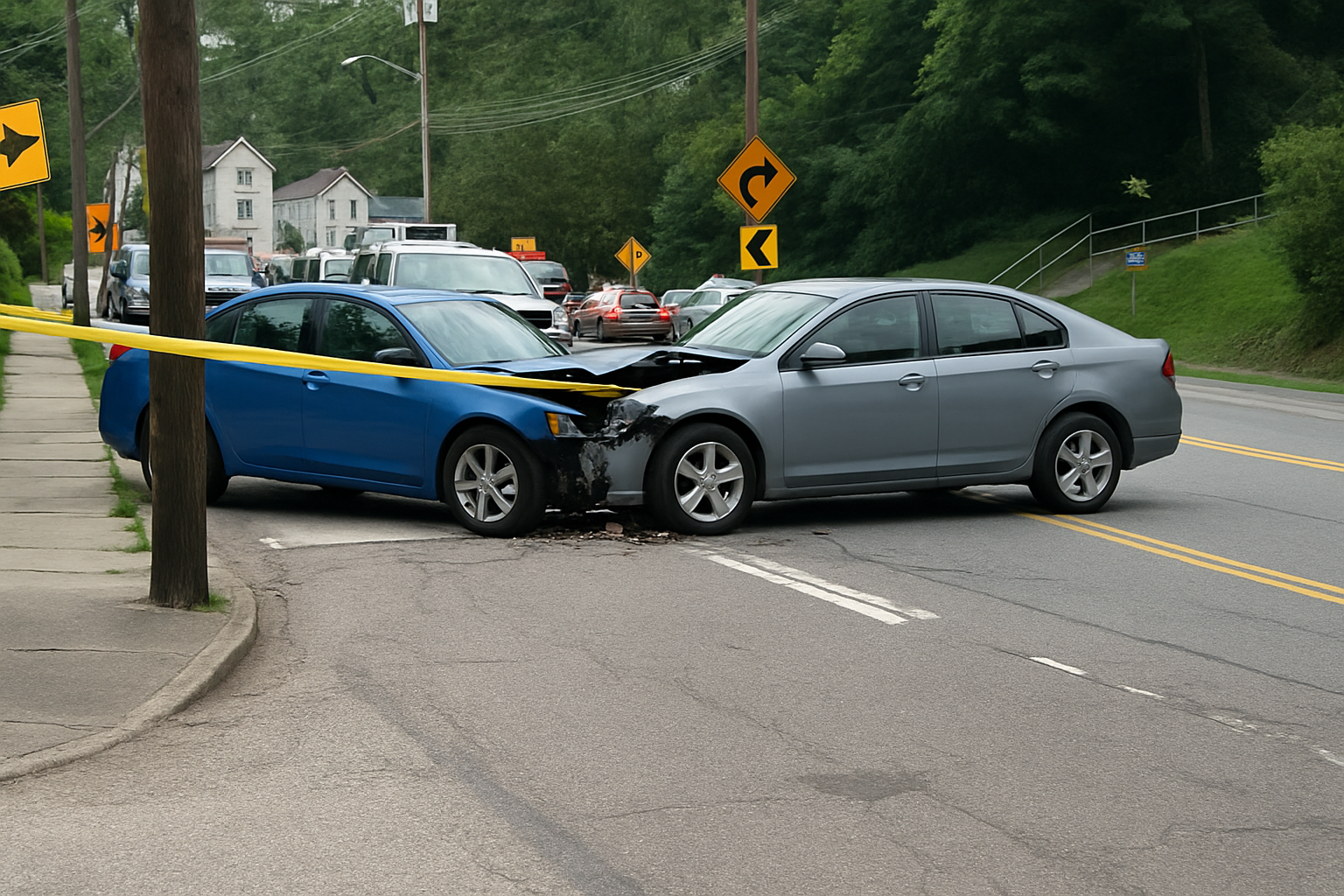
If you picked up two or more tickets or at-fault accidents in the same year, your rate increase is not additive — it's exponential. Carriers apply a frequency multiplier on top of each violation's base surcharge, and that compounds faster than most drivers expect.
Why Multiple Violations in One Year Hit Harder Than Multiple Years Apart
Carriers do not treat two speeding tickets the same way if they happen six months apart versus three years apart. When violations cluster within a 12-month window, insurers flag you as a frequency risk — a driver exhibiting a pattern rather than a one-time lapse. That distinction triggers compounding surcharges that go beyond the base rate increase for each individual violation.
A single speeding ticket typically raises your premium 20–30%. A second ticket within the same year does not add another 20–30% — it adds 40–70% on top of the first increase, depending on the carrier and your state. Some insurers apply a flat frequency multiplier of 1.5x or 2x to your total violation surcharge once you cross two events in 12 months. Others escalate the per-violation penalty incrementally. Either way, you are not paying double — you are paying exponentially more.
This compounding effect applies to any combination of violations: two speeding tickets, one speeding ticket and one at-fault accident, or three minor infractions. The carrier's underwriting algorithm does not care about the severity mix as much as it cares about the frequency. If you have two or more chargeable events in a rolling 12-month period, you have crossed into frequency-penalty territory. Texas point system and insurance impact Ohio's MVR impact on insurance rates
How Frequency Multipliers Work Across Common Violation Combinations
The math varies by carrier and state, but the pattern holds. A driver with one at-fault accident typically sees a 40–50% rate increase. A driver with one at-fault accident and one speeding ticket in the same year typically sees a 90–140% total increase — not the 60–80% you would expect from adding the base penalties. The second violation activates the frequency surcharge, which compounds the first.
Two speeding tickets in one year typically produce a combined rate increase of 50–80%, compared to 20–30% for a single ticket. Two at-fault accidents in one year can push your total increase to 120–180%, compared to 40–50% for one. If you add a third violation within the same 12-month window, expect the surcharge to exceed 150% in most states, and prepare for some carriers to non-renew your policy outright rather than price the risk.
These figures are approximations based on national carrier filings, and your actual increase will depend on your state's rating laws, your carrier's underwriting model, and your baseline rating factors like age, coverage limits, and prior history. But the compounding principle is universal: the second violation in 12 months costs more than the first, and the third costs more than the second. California's point system and surcharge rules Florida's violation surcharge structure
When Multiple Violations Trigger Non-Renewal or Assignment to Non-Standard Carriers
Not all carriers are willing to renew a policy after multiple violations in one year. Many standard-market insurers have underwriting guidelines that cap the number of chargeable events they will accept within a rolling 12- or 36-month period. Two violations in 12 months often triggers a renewal decline for drivers with no prior relationship or additional rating credits. Three violations in one year almost always does.
If your carrier non-renews you, you will need to shop the non-standard market — carriers that specialize in high-point, multi-violation, and post-suspension drivers. Non-standard carriers price frequency risk differently than standard carriers, and some are more aggressive than others. A few non-standard insurers apply lower frequency multipliers but charge higher base rates. Others apply steep multipliers but offer point-reduction discounts after 12 or 24 months of claims-free driving.
You may also see your policy moved to a non-standard affiliate of your current carrier rather than a full non-renewal. This is common with large insurers that own both standard and non-standard subsidiaries. The coverage stays in the same corporate family, but your premium jumps to reflect the non-standard tier. You are not required to stay with that affiliate — you can shop other non-standard carriers and compare rates.
In some states, if no voluntary market carrier will write you, you may be assigned to the state's assigned risk pool or residual market plan. This is rare for violations alone unless you have crossed into license suspension territory, but it can happen in states with strict underwriting caps on frequency risk.
How Long the Frequency Penalty Lasts and When Rates Begin to Recover
The frequency multiplier does not last forever, but it lasts longer than the base surcharge for a single violation. Most carriers apply the frequency penalty for the full surcharge period of the most recent violation — typically three to five years from the violation date, depending on your state and the violation type.
Points fall off your driving record according to your state's point system schedule, but insurance surcharges are not tied to point expiration. A carrier can continue to rate a violation for three to five years even if the points expire in two years. The frequency multiplier follows the same timeline. If your second violation occurred 18 months ago and your first violation occurred 24 months ago, you are still within the frequency window for most carriers until the second violation reaches the three-year mark.
Rates begin to recover as violations age out of the carrier's surcharge period. Once the oldest violation drops off, your premium should decline by the base surcharge amount for that violation. Once the second violation drops off, the frequency multiplier disappears entirely. At that point, your premium returns to your pre-violation baseline, adjusted for inflation and any other rating changes that occurred in the interim.
Some carriers allow you to accelerate rate recovery by completing a defensive driving course, maintaining a claims-free period, or bundling additional policies. These discounts do not erase the violations, but they can offset part of the frequency surcharge. Not all states or carriers offer these options, and the discount is usually capped at 5–10% of your total premium.
What to Do If You Have Multiple Violations in One Year
Shop aggressively. Carriers vary widely in how they price frequency risk, and the carrier that gave you the best rate before your violations may not be the most competitive now. Non-standard carriers like The General, Bristol West, Acceptance, and National General specialize in multi-violation profiles and may offer lower rates than your current insurer's non-standard tier.
Request quotes from at least three to five carriers, and provide accurate violation details including the dates, conviction types, and point values. Do not omit violations or misstate dates — the carrier will pull your MVR during underwriting, and any discrepancy will trigger a rate adjustment or policy cancellation. Most non-standard carriers quote using your actual MVR data, so accuracy up front saves time and avoids surprises.
If you are within six months of a violation aging out of the surcharge window, ask carriers whether they will re-rate your policy mid-term once the violation expires. Some will; most require you to wait until renewal. If you are close to the three-year mark on your oldest violation, it may be worth delaying a carrier switch until that violation drops off and you can shop the standard market again.
Check your state's point system rules to confirm when each violation will fall off your record and whether you are close to a suspension threshold. If you are one or two points away from a suspension, avoid any additional violations — even a minor ticket could trigger a license suspension, which adds SR-22 requirements and another layer of surcharges on top of the frequency penalty you are already carrying.
State-Specific Frequency Thresholds and How They Affect Your Rate
Some states regulate how insurers can apply frequency surcharges, while others allow full discretion. California limits the surcharge period to three years for most moving violations and prohibits carriers from applying frequency multipliers beyond the base surcharge for each violation. That does not mean you avoid a rate increase — it means the increase is additive rather than exponential.
Florida, Texas, and Ohio allow carriers to set their own frequency penalties, and most apply compounding surcharges once you cross two violations in 12 months. North Carolina uses a state-managed point surcharge system where points translate directly into annual surcharges paid to the DMV, separate from your insurance premium. If you accumulate 7 points in three years, you pay a $75 surcharge to the state; 10 points triggers $150; 12 points triggers suspension. The insurance surcharge from your carrier stacks on top of the state surcharge.
In Michigan, New York, and Pennsylvania, multiple violations in one year can also trigger mandatory driver responsibility assessments — state-imposed fees that run for multiple years and are separate from both your insurance premium and any court fines. These assessments are not insurance surcharges, but they add to your total cost of carrying multiple violations.
Before shopping for coverage, check your state's DMV website to confirm how many points you currently have, when each violation will expire, and whether you are approaching a suspension threshold. That baseline data will help you understand whether your rate increase is driven solely by insurance surcharges or compounded by state-imposed fees and assessments.